

Drought tightens its grip on farms in the Southeast
- May 15
- 2 min read
Data source: U.S. Drought Monitor
by Jeff Ishee
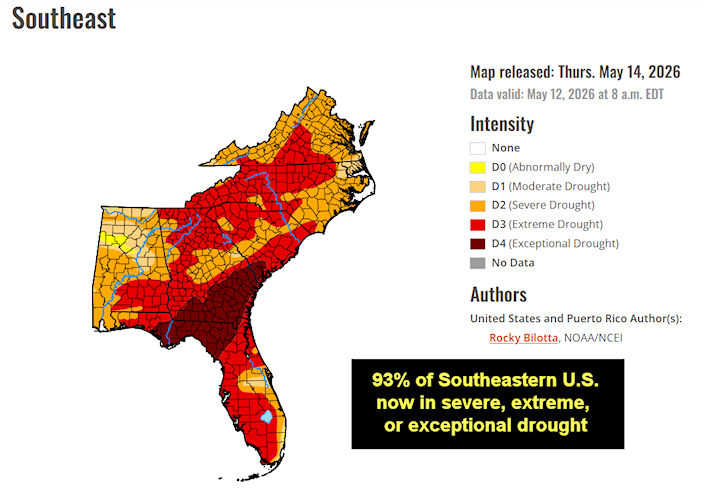
Drought conditions across the southeastern United States have intensified this spring, putting mounting pressure on farmers already contending with a challenging farm economy, labor shortages, high fuel prices, and depleted soil moisture. As of May 12, 2026, nearly the entire region remains in drought, with large areas classified in "severe" to "exceptional" categories — the most widespread spring dryness the Southeast has seen in decades.
Long‑term precipitation deficits dating back to mid‑2025 have left soils parched heading into the warm season. Many areas are running 8 to 16 inches below normal rainfall over the past nine months, preventing the usual winter and early‑spring recharge of groundwater, streams, and reservoirs.
For agriculture, the impacts are immediate and costly. Low soil moisture is hindering planting and germination for row crops, while pastures across the region are in "poor" or "very poor" condition, forcing livestock producers to feed hay far later than normal.
Farmer Genny Padgett with Huntington Farm, LLC in Surry County, Virginia, wrote on social media, "pastures dying. Hay fields dying. What corn came up was hit with frost in April. Other corn seeds stayed in the ground 20- 30 days before emerging. Currently feeding livestock with an already depleted hay supply. Unsure where hay is coming from for winter 26-27. Using every 1/2 tenth of rain to plant soybeans."
Fire danger has also increased as dry vegetation accumulates, adding another layer of risk for rural communities.
The May 12 drought map shows widespread short‑term agricultural impacts (D1–D4), with conditions especially acute in parts of Georgia, Florida, and the Carolinas. Without a sustained shift toward wetter weather, producers may face reduced yields, higher input costs, and continued strain on already‑tight water supplies.


Comments